
Let’s discuss the controversial topic of Pediatric Obesity and dive into the research we have on using nutrition to intervein and treat it!

Malnutrition that leads to obesity is putting children worldwide at risk for poor health.7, 9 In the United States, pediatric obesity is a common and serious problem.7, 8 There is prospect of curing this widespread issue by using the answers we have gathered through research studies.
Research studies of focus are those examining the use of medical nutrition therapy (MNT) to treat pediatric obesity. Causes of obesity are complex. MNT is arguably the most important area of focus when treating pediatric obesity because food and drink choices are the main contributors to childhood obesity.10 Poor diet is the leading risk factor and healthy eating has proven to be an efficient treatment option for childhood obesity.13 Reliable research is able to provide evidence to show consumers that treatment of pediatric obesity can be accomplished through proper assessment and diagnosis, having conversations about healthy eating with the child and parent(s), keeping the focus on health, implementing specific interventions, using a sensitive approach using nutrition prescriptions, and properly monitoring and evaluating behavior and measurements.
From a nutrition perspective, assessing pediatric weight and BMI should be done with a multifaceted approach. A nutritional assessment of children is done by obtaining, verifying, and interpreting pertinent data to make decisions about the nature and/or cause of a present nutrition-related problem.1 The healthcare provider should determine any existing medical conditions, reviewing medical records, gathering anthropometric data, and using BMI percentiles.1 All of these factors should be considered when moving forward to the potential diagnosis of pediatric obesity.1 Diagnosis is important because childhood obesity may persist lifelong if not treated properly, it can lead to adulthood obesity and a variety of metabolic and cardiovascular complications later in life.19 In diagnosing, dietitians are responsible for treating pediatric obesity independently. It is important to identify and label occurrence, risk, and potential of pediatric obesity.1
The principles of pediatric obesity treatment are nutrition-based, and intervention is the first step. Nutrition intervention is a set of fitting activities used to address the nutritional diagnosis of obesity. Healthcare professionals have tried a variety of nutrition interventions in attempt to treat childhood obesity. Effective interventions are based on pediatric MNT protocol for weight management. This protocol includes instructions and tools for assessment, education, and nutrition prescription.19 The trend among research studies on pediatric obesity treatments is that effective treatments promote healthful diet habits through nutrition education and nutrition prescription.14, 15, 19
This disease is of concern because a variety of evidence have shown the close relationship between childhood obesity and multiple serious health complications with a high risk of morbidity and mortality.9, 20 According to a research study20 on the use of metabolic profiles as biomarkers for insulin resistance in childhood obesity, “insulin resistance is the most common metabolic alteration related to obesity.” Insulin resistance (IR) refers to an impaired response of the body to insulin, resulting in elevated levels of glucose in the body. IR represents an important link between obesity and type 2 diabetes and other metabolic risks such as cardiovascular diseases.20 This study concludes that amino acid metabolism and lipid metabolism seemed to be mainly affected in obese children when comparing with nonobese children. Identifying children with IR can be an effective strategy for preventing and treating childhood obesity-related complications.20
One research study10 used MNT protocol with handouts (known as KIDPOWER) as a treatment method for overweight children in nine primary care practices in North Carolina. Data that was collected and analyzed included patient medical records, height, weight, and patient and parent-reported diet and TV behaviors.9 This information was collected at each patient visit with a Registered Dietitian (RD). The KIDPOWER protocol was delivered by an RD and the handout highlighted behaviors believed to be important for the prevention of and/or treatment of overweight and obesity. Children that qualified to receive RD MNT consulting within the capacity of this study met standardized measurements: a BMI ≥ 85th percentile for age and gender and were aged 2 – 20 years.9, 15
BMI’s for children are used on a percentile basis determined using an age and sex-specific percentile rather than the BMI categories used for adults.15 Children’s height and weight were recorded because the formula for BMI is an individual’s weight in kilograms divided by height in meters squared (see chart below).2, 10 According to the Center for Disease Control, research has shown that BMI is correlated with direct measures of body fat. Normal or healthy pediatric weight will be indicated by the 5thpercentile to less than the 85th percentile, whereas the 85th to less than the 95th percentile indicates overweight and the 95thpercentile or greater indicates obese.2
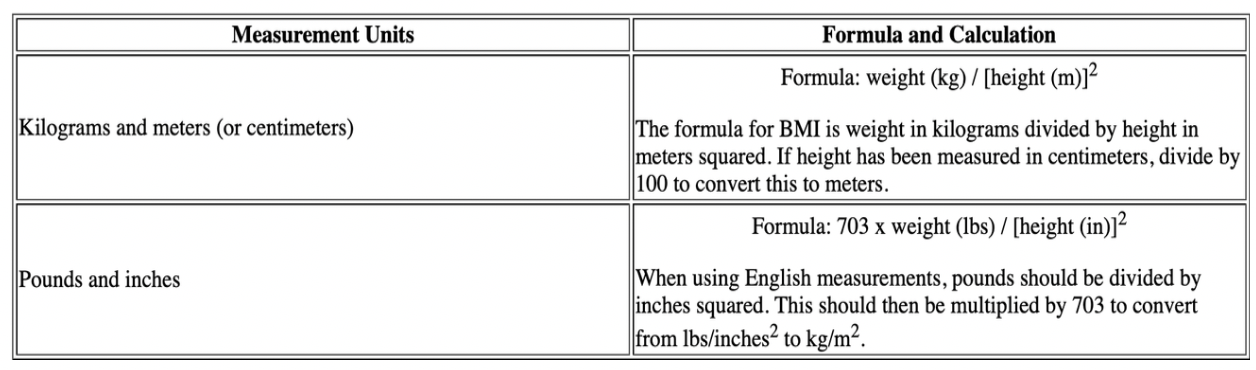 The chart above displays the measurement units and formulas for accurately calculating BMI.2
KIDPOWER10 was created by using pediatric weight management protocol and diet trends recorded from families and children with obesity. The goals of KIDPOWER10 were to promote behaviors that acted as treatment measures for pediatric obesity. These behaviors and goals included the following: increase consumption of fruits and vegetables, decrease consumption of soda and other sugar sweetened beverages, reduce eating out, and decreased TV viewing time.3, 5, 10, 13 Results of this study10showed that by the third week of MNT consulting families, children and parents were able to make lifestyle changes that influenced positive change and proved effective for pediatric obesity treatment. The conclusion is that KIDPOWER can be “successfully delivered by an RD to overweight youth in their medical home.” 10
Reasons to explain why the KIDPOWER research study10 handout included the specific information that it did can be found in various other research studies. As previously stated, the most important behavior change is related to eating. There’s no such thing as “good” food and “bad” food.12 Foods and ingredients are more accurately classified as healthier and unhealthier.13It’s typically unhealthy foods and eating patterns that can lead to obesity.13, 14 Research16 provides evidence that pediatric obesity commonly coexists with stress. Therefore, a child’s level of stress and sources of stress should be discussed and considered when beginning conversation about eating behavior.
Obesity primarily develops from a prolonged excessive energy imbalance caused by calorie consumption that exceeds an individual’s energy requirements.5, 13 Setting MNT goals for pediatric obesity treatment should be specific so that parents have instruction and feel that change is possible.3 An effective intervention is to increase fruit and vegetable servings because is theorized to reduce energy intake by reducing intake of more energy-dense foods, such as snack foods.10 If accomplished, energy balance is positively impacted and helps to improve weight status because fruits and vegetables are lower in calories than most processed snack foods.1 The same concept is true for why parents and children should be advised to reduce and limit sweetened beverages such as juice and sodas. These beverages can be replaced with water, low-calorie carbonated beverages, and skim or 1% milk.10 In fact, one of the first studies examining children’s low-fat milk consumption potential impact on obesity found that “low-fat milk may reduce obesity.” 18
The pediatric obesity prevalence is continuing to increase.8 This disease is associated with an increased risk of cardiovascular disease and premature death.9 An important intervention is limiting saturated fat and eliminating trans-fat consumption.5 Research5, 6 provides evidence that saturated and trans-fat consumption can cause cardiovascular disease; especially, the commonly seen left and right ventricular remodeling (increased myocardial mass and thickness) and contractile dysfunction (impaired longitudinal strain). Results suggest a common mechanism may be the underlying factor of both remodeling and dysfunction of the left and right ventricles of children that meet obese criteria.11 A specific goal for families is to have all family members drink skim or low-fat milk as a behavior change to treat pediatric obesity.6, 11, 13
It isn’t typical that children are grocery shopping for the family; therefore, the most effective interventions are geared toward parents. We know from research10 that the more controlling and restrictive parents are with food, the more likely the kids are to develop obesity. Children go out into the world eventually and food is available in most daily settings.10 Early diagnosis and use of MNT interventions for obesity statistically tend to yield better outcomes and means children are more successful in changing behavior.13 It’s important to keep the focus on health and not make the parents feel blamed for their child’s weight status. Evidence suggests that parental involvement has resulted in effective interventions.3
Nutrition education guides each intervention. Parents and children should be educated and informed of the meaning of recommendations. Omitting the previously described “why” behind recommendations decreases the likeliness of positive eating behavior change. Evidence shows that parents and children can accommodate an increased level of health literacy and improved clinical measures by using nutrition education.8 Research surveys tell us that after receiving the education participants show an increase in skill level and comfort with nutritional concepts while engaging in interactive cooking and meeting with an RD.8
As previously stated, nutritional goals and interventions for treating pediatric obesity should be specific. According to the protocol for pediatric weight management15, a nutrition prescription should be written. A usual nutrition prescription is modified carbohydrate meal planning and should include the following: 40% Carbohydrate, 30% Protein, 30% Fat; (40-30-30); 45-25-30 may also be appropriate depending on activity level.14, 15, 19 When applicable, parents should be advised to encourage their child to participate in physical activity. Decreased or little physical activity is associated with pediatric obesity and therefore a strong recommendation for treating obesity is the reduction of inactivity accompanied by nutrition prescription.19
An important eating behavior to note and discuss with parents is watching television while eating snacks and meals. This behavior is not advised. A meta-analysis research study9 suggests that increased television watching is associated with an increased risk of childhood obesity. Also, restricting television time and other sedentary behavior of children may be an important public health strategy to prevent childhood obesity. Eating dinner as a family with a fun and engaging, not criticizing, manner should be recommended.9
Numerous follow-up consulting visits with an RD have proven to be effective in the treatment of pediatric obesity.10Monitoring and evaluation can take place in many forms. Progress should be measured by the presence or absence of recommended behavioral changes. If positive change is absent, then the cause should be identified. If behaviors have changed and followed recommendations, then new goals should be set to continue treatment. For example, a goal for parents may have been to have their child consume one additional serving of fruits or vegetables every day. If this was met, then the next goal would be to have their child consume one more additional serving of fruits and vegetables per day. A usual weight goal is weight maintenance until reaching a BMI below the 85th percentile; however, if weight loss occurs with a healthy, adequate-energy diet, it should not exceed 0.5 kg/mo19. If greater weight loss is noted, then the child should be monitored for causes of excessive weight loss. The next weight goal is weight loss but not exceeding the average of 0.9 kg/wk.19
For many reasons, medical nutrition therapy is an important area of focus when treating pediatric obesity. “Lifestyle issues — too little activity and too many calories from food and drinks — are the main contributors to childhood obesity. But genetic and hormonal factors might play a role as well. For example, recent research has found that changes in digestive hormones can affect the signals that let you know you’re full.”4 Early childhood is a critical period for obesity treatment interventions because children are developing behaviors to be carried into adulthood.12 Ideally, these learned healthy behaviors during childhood will be implemented over the life course to prevent future obesity.
Pediatric obesity is a growing public health problem.7-9 Obesity primarily develops from prolonged excessive energy imbalance caused by calorie consumption that exceeds an individual’s energy requirements. 5, 13 Effective behavioral interventions include parental support, delivery of basic instructive information on healthy nutrition and physical activity, implementing fitting interventions, and properly monitoring and evaluating progress from one consultation to the next. The reported research results are compatible with current evidence-based guidelines. This research demonstrates the usefulness of RD’s delivering MNT to overweight children. Collectively, the available evidence provides a basis for further study of providing MNT to overweight children by an RD following standard protocol.
References
- Barlow SE and the Expert Committee. Expert committee recommendations regarding the prevention, assessment, and treatment of child and adolescent overweight and obesity: summary report. Pediatric 2007;120 Supplement December 2007:S164-S192.
- BMI Formula – CDC. Cdc.gov. https://www.cdc.gov/healthyweight/assessing/bmi/childrens_bmi/childrens_bmi_formula.html. Published 2019. Accessed November 22, 2019.
- Chai, Li Kheng, Tracy Burrows, Chris May, Katherine Brain, Denise Wong See, and Clare Collins. “Effectiveness of Family-based Weight Management Interventions in Childhood Obesity: An Umbrella Review Protocol.”JBI Database of Systematic Reviews and Implementation Reports 9 (2016): 32-39. Web.
- Childhood obesity – Symptoms and causes. Mayo Clinic. https://www.mayoclinic.org/diseases-conditions/childhood-obesity/symptoms-causes/syc-20354827. Published 2019. Accessed November 21, 2019.
- Cohen, Jennifer, Shirley Alexander, Michelle Critekos, Sarah P Garnett, Alison J Hayes, Tim Shaw, Kyra A Sim, and Louise A Baur. “The Acceptability, Effectiveness, and Impact of Different Models of Care for Pediatric Weight Management Services: Protocol for a Concurrent Mixed-methods Study.”BMC Health Services Research1 (2018): 417. Web.
- Cote AT, Harris KC, Panagiotopoulos C, et al. Childhood obesity and cardiovascular dysfunction. J Am Coll Cardiol. 2013; 62 (15):1309-1319.
- Defining Childhood Obesity | Overweight & Obesity | CDC. Cdc.gov. https://www.cdc.gov/obesity/childhood/defining.html. Published 2019. Accessed November 21, 2019.
- Fals, Angela, and Christopher Schnell. “Innovative, Multi-level Nutrition Education Program within a Hospital-based Childhood Obesity Prevention and Treatment Program.”Pediatrics (2019): 1. Web.
- Jing L, Pulenthiran A, Nevius CD, et al. Impaired right ventricular contractile function in childhood obesity and its association with right and left ventricular changes: a cine DENSE cardiac magnetic resonance study.J Cardiovasc Magn Reson. 2017;19(1):49. Published 2017 Jun 28. doi:10.1186/s12968-017-0363-5
- Gang Zhang, Lei Wu, Lingling Zhou, Weifeng Lu, Chunting Mao. Television watching and risk of childhood obesity: a meta-analysis. European Journal of Public Health. 2016;26(1):13-18. Doi:10.1093/eurpub/ckv213.
- Henes, Sarah T, David N Collier, Susan L Morrissey, Doyle M Cummings, and Kathryn M Kolasa. “Medical Nutrition Therapy for Overweight Youth in Their Medical Home: The KIDPOWER Experience.”Patient Education and Counseling 1 (2010): 43-46. Web.
- Koplan, Jeffrey P, Catharyn T Liverman, and Vivica I Kraak. “Preventing Childhood Obesity: Health in the Balance: Executive Summary.”Journal of the American Dietetic Association 1 (2015): 131-38. Web.
- Looney, S.M.; Raynor, H.A. Are Changes in Consumption of “Healthy” Foods Related to Changes in Consumption of “Unhealthy” Foods During Pediatric Obesity Treatment? J. Environ. Res. Public Health 2015, 9, 1368-1378.
- “New Diet and Nutrition Study Findings Have Been Reported by Researchers at University of Montreal.”Obesity, Fitness & Wellness Week (2018): 4123. Web.
- Pediatric Medical Nutrition Therapy Protocol for Weight Managem. Ecu.edu. https://www.ecu.edu/cs-dhs/pedsweightcenter/CustomCF/protocol/06_MntForWtMgmt_09.pdf. Published 2019. Accessed November 20, 2019.
- Pervanidou, P., & Chrousos, G. P. (2016). Stress and pediatric obesity: Neurobiology and behavior.Family Relations, 65(1), 85-93. doi:http://dx.doi.org.pearl.stkate.edu/10.1111/fare.12181
- Shannon M. Looney, and Hollie A. Raynor. “Are Changes in Consumption of “Healthy” Foods Related to Changes in Consumption of “Unhealthy” Foods During Pediatric Obesity Treatment?”International Journal of Environmental Research and Public Health 4 (2012): 1368-378. Web.
- “Study Finds Low-fat Milk May Reduce Obesity.”Dairy Markets Weekly (1999): 7. Web.
- Yi, Dae Yong, Kim, Soon Chul, Lee, Ji Hyuk, Lee, Eun Hye, Kim, Jae Young, Kim, Yong Joo, Kang, Ki Soo, Hong, Jeana, Shim, Jung Ok, Lee, Yoon, Kang, Ben, Lee, Yeoun Joo, Kim, Mi Jin, Moon, Jin Soo, Koh, Hong, You, Jeongae, Kwak, Young-Sook, Lim, Hyunjung, and Yang, Hye Ran. “Clinical Practice Guideline for the Diagnosis and Treatment of Pediatric Obesity: Recommendations from the Committee on Pediatric Obesity of the Korean Society of Pediatric Gastroenterology Hepatology and Nutrition.”Korean Journal of Pediatrics 1 (2019): 3-21. Web.
- Zhao, Xue, Xiaokun Gang, Yujia Liu, Chenglin Sun, Qing Han, and Guixia Wang. “Using Metabolomic Profiles as Biomarkers for Insulin Resistance in Childhood Obesity: A Systematic Review.”Journal of Diabetes Research 2016 (2016): 8160545. Web.
 tabletalk.blog