
The Set-Point Theory… 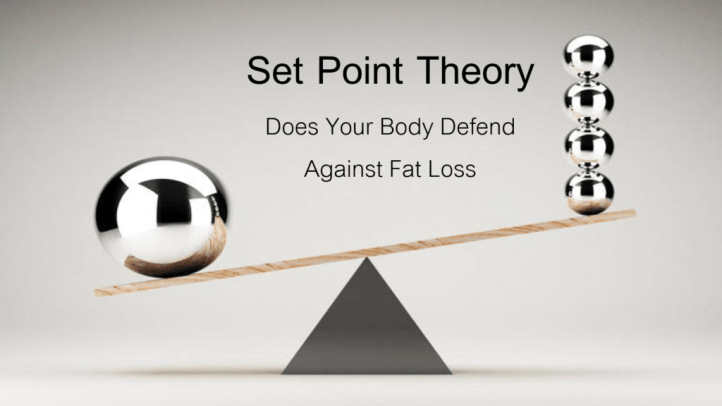
Have you ever tried losing weight and it doesn’t seem like the changes you have made are working, so you blame your body? The set-point theory is a theory telling us that you might be right; that it’s your brain telling your body to maintain a certain weight whether or not you want to be at that weight. The set-point theory is just a theory. There is evidence to support the set-point theory, the evidence against the theory, more to be discussed about it, and practical implications we can take away from this theory about weight.
The set-point theory supports the idea that body weight is sustained at a moderately stable level for long periods of time. An abstract published on PubMed about the role of set-point theory in regulation of body weight includes evidence negating the theory. It states that this theory suggests our weight is predetermined or preferred for us, rather than us having dominant control over our weight via lifestyle choices, by a feedback control mechanism in our body. Information from our body signals the hypothalamus to take action. This action pertains to our weight as it modulates food intake or energy expenditure to correct any deviations in body weight from its preferred set-point (usually a small range). At this point, it seems the study may be supporting the set-point theory; however, the study continues to examine other hypotheses pertaining to roles of nutrients, dietary composition, hormones, neural pathways, brain nuclei, and many other regulators of food intake. This study concludes that “regulation of body weight in relation to one specific parameter related to energy balance is unrealistic.” (Harris, 1990)
While searching over the internet for clear and concise evidence in support of the set-point theory, I found it was difficult to find just that from a reliable source. What I ended up finding was a PDF created by the Government of Australia that was a resource for the Centre for Clinical Interventions. At this Centre, they offer psychological therapy. Their PDF clearly assumes that the set-point theory is a concept that isn’t debatable even though it states, “research suggests” and that genetics play a large part in determining our weight but goes on to list other factors. The PDF relates the theory to eating disorders. I just had to know if and how this Centre for Clinical Interventions used the set-point theory, so I emailed them! They got back to me rather quickly and they do use the set-point theory! The email made it seem that assumed people would read this sheet and imply that because it states “theory,” people will be cautious. Yet, without breaking client-patient privilege, the email explained how the set-point theory has given hope to many individuals suffering from an eating disorder. They believe that our bodies have developed mechanisms to keep our body in a weight range through evolution to protect us from starvation (Centre for Clinical Interventions, 2018).
Unfortunately, this is not enough evidence to support or negate the set-point theory. Another study published on PubMed thoroughly examined individual aspects of our body’s mechanisms related to the set-point theory. Throughout the study, small bits of evidence both supporting and refuting the set-point theory were exampled. In one case an individual failed to continue small diet changes, and thus of maintaining a reduced weight, may be taken as evidence for the inaccuracy or even inefficiency of our weight control system to defend a ‘new’ set-point. Alternatively, the programmed regaining of body weight may be used as evidence supporting a high set point. This seems to be well defended in individuals who are overweight and obese in this study. Separately, the study found that there is some evidence supporting the heritability of feedback signals in the body that influence body fat mass. Lastly, the study uncovered some evidence suggesting that adipose tissue distribution is genetically (or epigenetically) programmed (Muller, et al., 2010).
As you can see, there is more to be discussed about the set-point theory. I believe it seems appropriate to assume that the level at which body weight and body fat content are maintained represents the equilibria achieved by the regulation of many parameters. I believe there is some truth behind the concepts of the set-point theory because we do have various regulatory processes occurring in the body. However, I think that this theory can lead people astray because it is too narrow of a concept.
We can take so much away from learning about the set-point theory. For starters, believe that you are in control of your own body; make the choices that support your health goals. Your body regulates homeostasis in weight and your genes play a role, but only to an extent. Think about nurture versus nature. We can change our set point range of weight because it’s only a piece of the weight loss/gain puzzle. We know that positive changes in nutrition, eating habits, exercise, and physiological factors collectively play a role in weight. Let that be your motivator.
Our bodies are fascinating. We don’t have to think and tell our body to maintain our weight as we eat and move around every day; it just does it! The set-point theory suggests that our bodies have a preferred weight that it will work to maintain, regardless of what we think or try to change. There is evidence is that our body will readjust an individual’s weight regardless of small dietary changes to support this theory. And there is evidence such as studies concluding that set-point theory is unrealistic because energy balance does not pertain to only one specific parameter. Together, we concluded that there is so much more to weight loss and gain than the set-point theory suggests. We can make changes to positively impact our health through changes in nutrient consumption, eating habits, exercise, environment, and more.
What are YOUR thoughts? Comment and I’ll get back to you as soon as can!
Sources
Government of Western Australia. “Set Point Theory.” Centre for Clinical Interventions, 2018,
www.cci.health.wa.gov.au/~/media/CCI/Mental%20Health%20Professionals/Eating%20Disorders/Eating%
20Disorders%20-%20Information%20Sheets/Eating%20Disorders%20Information%20Sheet%20-%2024%20-%20Set%20Point%20Theory.pdf2.
Harris, R B. “Role of Set-Point Theory in Regulation of Body Weight.” FASEB Journal : Official Publication of the
Federation of American Societies for Experimental Biology, U.S. National Library of Medicine, Dec. 1990,
www.ncbi.nlm.nih.gov/pubmed/2253845.
Müller, Manfred J, et al. “Is There Evidence for a Set Point That Regulates Human Body Weight?” F1000 Medicine
Reports, Medicine Reports Ltd, 9 Aug. 2010, http://www.ncbi.nlm.nih.gov/pmc/articles/PMC2990627/.
 tabletalk.blog